ON QUEER LAND
An ecological movement & performance project supporting LGBTQIA+ health in the Welsh borderlands

On Queer Land, Presk Wood, Redbrook.
On Queer Land was an interdisciplinary arts project developed with and for the rural queer community living in the Welsh borderlands. The project was designed as part of my MA Arts, Health & Wellbeing in response to a lack of safe queer spaces in my local community. Drawing on my own lived experience, the project explored how limited LGBTQIA+ visibility can affect the ability to build queer community and support health and wellbeing in often isolated rural areas. The project was supported by Field Notes / Nodiadau Maes CIC, an emerging rural collective of queer makers exploring what it means to build accessibility, inclusivity, and community through slow, gentle, land‑based practices across the Welsh/English borders.
Through movement, mark-making and reflection, participants were invited into gentle reconnection with themselves, their bodies, and surrounding landscapes. Guided by counter-storytelling (Delgado, 1989), a liberatory and community-building practice, the project made space to reauthor queer and rural lived experience, build solidarity, and explore new artistic methods and approaches for uplifting queer voices in spaces where they are often marginalised. Throughout the project, participants explored and shared their experiences of place, identity and belonging, highlighting the many ways queer people navigate rural spaces where their identities are often made to feel invisible. The project created a sense of community and safety, an opportunity to form new friendships, and a space to reimagine more inclusive queer and rural futures.
Read on to explore the groups reflections of moving and performing with the landscape as they emerged throughout the workshops.
With thanks to Aimee Blease-Bourne for supporting this project, to Fawn Fae for their photographic documentation of the workshops, and to Bronwen Rashad-Wilson, Carli Ma, Caroline White, and Rachel Adams for bringing so many wonderful moves, dances and creative insights to the project.
Symbols, Movements, Gestures


Symbols, movements and gestures emerge from marks made with charcoal, earth and tempera pigments.
St. Saviours Church, Redbrook, 2026
Choice was central to creating a safe and inclusive environment that honoured the diversity of queer lived experience. Through movement, mark-making, and sensory nature prompts, the group were invited to move fluidly between different forms of expression, and participate in ways that felt most meaningful and accessible to them in the moment.
Reflecting & Documenting

Creative reflection was embedded throughout the project, creating space for choice, self-expression and diverse perspectives. Participants shared and responded to the landscape and to each other through moving images, writing and photography throughout the in-person workshops and through the project’s online community platform via the 'Padlet'app.
Reflecting on workshop themes via in-person and digital reflection spaces


A Return to Self

“The mark-making was a reflection of my queer self flowing through me...like water. The movement gesture had an uncertainty to begin with, moving off center and balance...but with a constant returning to self.”
Movement Stories
Participant reflections on the connection between landscape and queer identity through mark-making, movement & gesture.
Moving and reflecting with nature, Presk Wood, Redbrook.

Mindful, Soft, Aimee Blease-Bourne, 2026
Moss, Bark, Stone, Skin, Carli Ma, 2026
“My body did not stand apart from the landscape, it molded, sank and softened into all that was.
It was a feeling of being deeply accepted, a belonging and coming home that is always felt.”
Seeing the Unseen
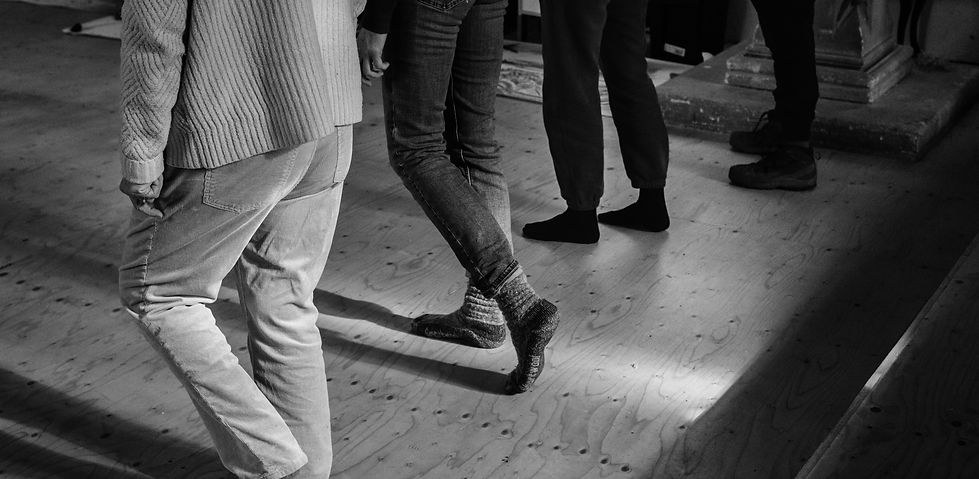

Turning toward the horizon. St. Saviours Church, Redbrook.
"It was about being next to each other, all facing something together, but taking steps in really different ways. There was a chance to step back and think, 'where do I fit within this?,' rather than being carried away by the rest of society.”

Participant reflections on moving & improvising. St. Saviours Church, Redbrook.
“There's something about being able to move with presence and poise. To just be, and not do what is expected. It just helps to deconstruct things, doesn't it? in a very gentle way.”


“There’s something I enjoy about being an outsider. There's a strength in it, isn't there? ....in being able to step back and see it all. Like queerness, we can celebrate that outsiderness as well, and the perspective that brings you.”
“Bird’s Eye View” Charcoal on paper, Caroline White, 2026
Reclaiming
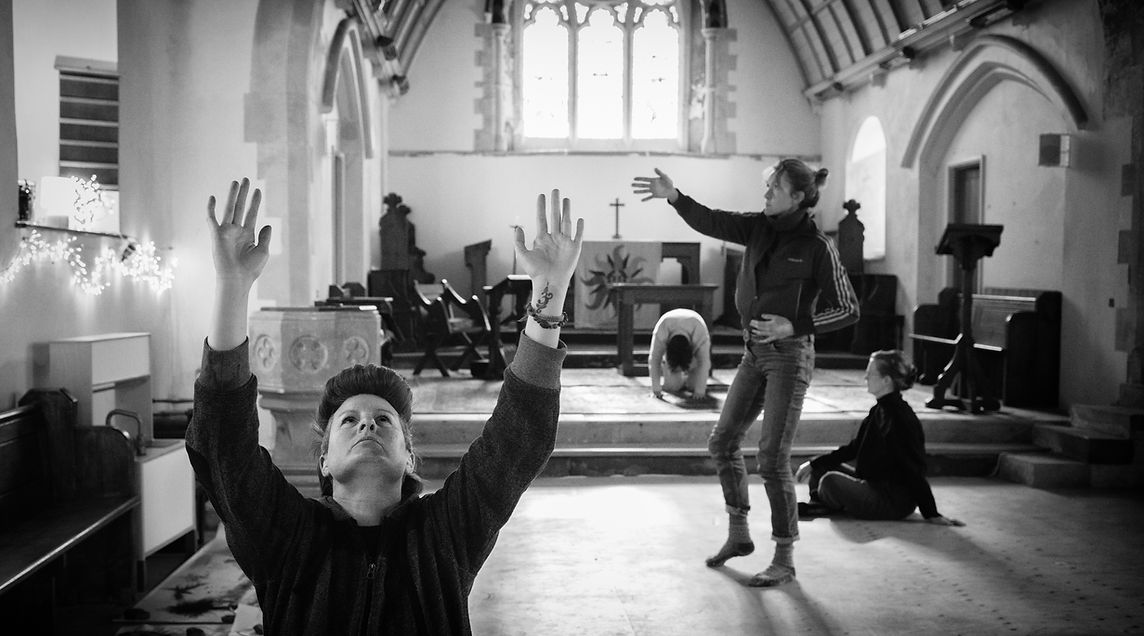
“What I found most powerful was the dance we created, maybe because I’ve never been a dancer, and maybe that’s why I found it so powerful. It really created a sense of community with each other and that place. I really feel like I can go back to that place, and feel at home there.”

On Queer Land Dance excerpt, Presk Wood, 2026
This video has sound
“It’s knowing that it's okay to take your space. In my queer experience, when you're walking with the land you know you belong, because nature belongs, and it’s okay for you to be here.”

Solidarity, Presk Wood, Redbrook, 2026
“As queer people, there is this narrative that is put on you that queer people leave the countryside, but that just isn’t true....So how can we take this knowledge from here and use it to create the conditions we want in the future?.”
On Queer Land, 2026
Delgado, R. (1989). Storytelling for Oppositionists and Others: A Plea for Narrative. Michigan Law Review, [online] 87(8), pp.2411–2441. doi:https://doi.org/10.2307/1289308.